Custom Search

Affandi 'The Master'


Affandi Museum is just located at Jalan Solo, at the west bank of the river of Gajah Wong, where you could enjoy at least 300 paintings by Affandi himself. He is a famous and very talented person in painting who has a unique way to do his paintings, using only his fingers.
He never attended the arts school, his talent is a gift from God, since he was very young, where he uused to express his ideas through his paintings. When he got an idea he will then put it in a canvas using his fingers on his hands, just like a person on 'trance', and he will finish his job very soon.
Most of his paintings are 'ultra expressionist', probably one of the only small numbers of painters of this kind in the world.
He was a simple man, always wearing a T-shirt and 'sarong', a Javanese style clothing for leisure time. His great talent inherited by his daughter Kartika, who now become the owner of the museum as well as the curator

The Royal Wedding


The old centuries ceremony which is actually the harmonic combination between Islamic and Hindu, influenced by the Javanese Royal Family culture, will be accompanied by the mystical sound of Javanese percussion orchestra or 'gamelan' reverberated throughout the sprawling ornate Yogyakarta Sultanate Palace, where the royal wedding was held last time.
Both the bride and the groom dressed in specially designed and made motif batik clothes, then a special traditional dance which was created by the late Sultan himself long time ago, also performed by nine female dancers from the royal family who is still virgin.
According to the wedding committee, at least two tons of various flowers primarily roses of different colors and jasmine utilized during the ceremony.
To allow the resident of Yogyakarta to witness this rare opportunity to catch a glimpse of the Royal Coupled , there was also a parade featuring horse carriages which was pulled by six horses, where the bride and the groom crowdaround surrounded the palace.

wedding

The Javanese Keris


The traditional pointed weapon of Javanese which always brought everywhere in the past times especially by Javanese nobel where it could also show the social status of the owner. This culture
predicted start in the VIth century, and then spread to allover Indonesia and surrounding countries included Malaya (now Malaysia), the Philippines, Thailand, and Cambodge. The name and terminology of the keris itself was founded in Java in the year of 824, but the oldest keris was discovered in Magelang Regency, Central Java in the year of 500.
The length of the keris is ranging from 35 cm to 50 cm and also depending upon from where it was made. It is also consiidered as " a masterpiece of the oral and intangible heritage of humanity " by the UNESCO and this declaration was base upon not only the historical value but also the fact that the tradition of Javanese keris is actually a living culture, which is still exist until today, and have both special and unique status in the Javanese society.

Centre of handicraft


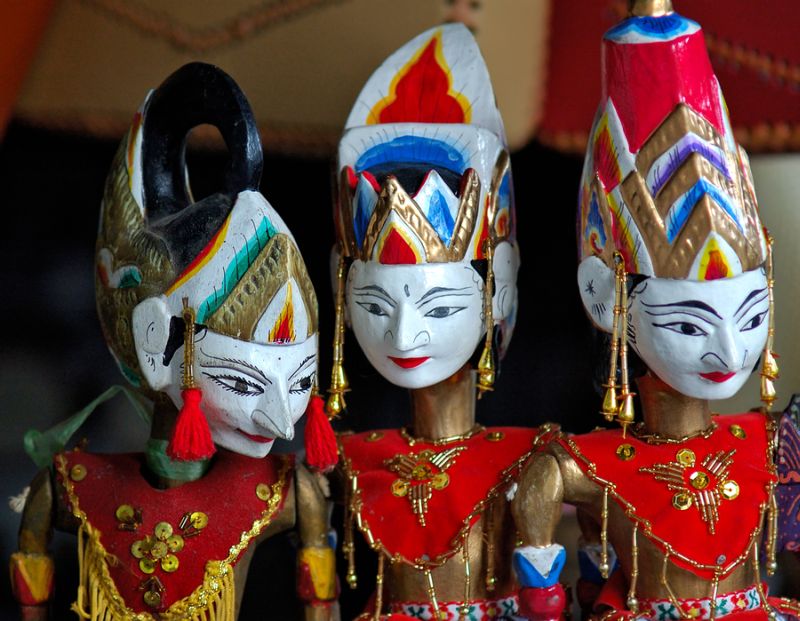
For wood carving, the centre is located about 30 km southeast of Yogya at Bubung, lies on a hilly area with fresh air, where almost the villagers are wood carvers who make masks, statues, and typical Yogya bridal statue, called 'Looro Blonyo'. They also offer a classical love story mask dance.
Bamboo handicrafts village is centered in Tietoadi, Sleman, it's about 8 km west of Yogyakarta, where visitors could get the products directly from the craftmen or perhaps you want to learn how to make it, they're reday and happy to teach you all.
Wrought iron makers center is located about 60 km east of Yogya, at Gorotan village. They produce old style lamp, ornamental iron works, garden furniture and other made ot order works.


Wicker work products are made in Moyudan, 12 km west of Yogya where visitors can learn how to amke a simple wicker. Whie glass painting arts can be found at Muntilan, whiich featured either Rmayana epic or Islamic themes. It's close to the Borobudur Temple.
Copper goods are produced in Cepogo village, Boyolali, about 60 km north of Yogya, just below the volcanic mountain of Merapi. They produce pots, pans, home accesories, lighting fixtures, sculptures etc. While terracota, pottery, and all about earthenwares are produced in both Bantul, about 10 km south of Yogya and Klaten county, about 30 km east of Yogya.
Gold and silver craft can be found mostly in Kotagede the southpart of Yogya, where you could get a lot of variety products of silver and gold while visiting the old city of Yogya villlages with its
specific architectures and life style.
Bon voyage !

Cultural Villages


These villages are located around the centrum of Yogya, i.e. the Sultan Palace, where each village has its own uniqueness to offer to visitors, like the architecture of the buildings, the daily life and activities of its people, such as farming, animal husbandry, and cultural activities , including traditional dancing performances and arts exhibitons.


Some ot them are, Tembi Village, located about 8 km south of Yogya, where visitors can stay in a home stay runs by villagers and enjoy traditional performances and art exhibitions.
Kebon Agung Village, it is located 17 km southeast of Bantul Regency, where visitors can observe farmers' daily activities like cultivation and animal farming, they also offer traditional performance and food festival as well.


Sleman Regency has Tanjung Village, located 10 km north of Yogya, where visitors can enjoy the Javanese hospitality while feeling the sense of living in a village inside the 200 year old traditional Javanese home. You might learn how to do rice farming or duck shepherding as well.

The River of Code


Unlike The Thames in London, The Seine in Paris and The Tibre in Rome, the Code river is not just a river which cuts through the city, it is actually a home, a community of the poor, who have nowhere to live and stay in a formal living spaces. Most of them are migrant workers, included an ex criminals, buskers, pickpockets, pedicab drivers, even prostitutes, and perhaps many more unusual positions, you just name it.
It also become a centre of activities and life as well where despite of the dark grey-brown with buoyed rubbish, they use the water of the river to bath and wash the cloth. Miraculously, they're well so far, thanks God ! (probably not yet get the disease, who knows ?).
This community also contains some small scale industries, like tofu home industry, and herbal traditional medicine makers. All of them exist here, people who escape from social expectations and mostly have unconventional jobs.
Everything has its own good and bad side, and the Code river might be the ugly side of the city of Yogya, where you won't go fishing here, will you ?