Custom Search

Bedog River Arts Festival


The people of Yogyakarta welcome The Javanese New Year 1 Syuro with a ritual called 'topo mbisu' which is to walk around the palace of the Sultan without talking anything. It is to symbolize that people should actually introspect and contemplate as well continuously in order to get better and better to themselves as well as to the nature and environment. This arts performance is actually                                                                                                      to celebrate the relationship between human, nature and the river, held once a year. This year on November 29 to December 1 the performance will be held at a natural outdoor landscape around the river of Bedog in Banjarmili Dance Studio, Gamping ,Yogyakarta. It would be attended by more than 25 performers from Japan, Myanmar, Venezuela, The Netherlands, and Indonesia.
The 'theme' of the 2012 festival is "Connecting Creative Generation in the middle of Diversity" ,
It also will be enriched by photo exhibition/competition, workshop, poetry reading, theater play, music concert, and traditional performances.

Street and Traffic


Upon arrival, visitors especially foreigners would likely feel a bit astonished or, even dumbfounded when witnessing the colorful street of Yogya. You will suddenly be grabbed by the honking horn of hanky-panky motor bikers, which clogging up every space in the street even in an alley.
They move around weaving their way through the traffic snakely almost everywhere. You may also hear strange noises like tok2 or ting2 or probably a musical sounds which come from food sellers, followed by a strong smell of chicken BBQ or fried catfish. Food sellers are almost everywhere with various tastes, you just name it.
While you enjoy food, street musicians will be approaching you and play their simple music, it is not a 'pro bono' action, you may give a charity to them. Like it or not you would also find murals in every space in the city, commercial ads from viagra, cigarettes, cars, homes, not to mention political ads. They're all mixed and vibrate the city of Yogya. Bon Voyage !!!

Royal Wedding of Yogyakarta


England just had its Royal Wedding earlier this year,  and Yogya already made its own history  in October 18, 2011  became the setting for  the second  Java’s own grand royal wedding between Princess Gusti Raden Ajeng Nur Astuti Wijareni, youngest daughter of the Sultan of Yogyakarta, and Achmad Ubaidillah from Lampung , Sumatra, following the marriage of the first daughter of Sultan several years ago. 
The entire festivities will last four days from , with the actual wedding ceremony scheduled to take place on Tuesday, 18 October 2011. The date chosen for this memorable occasion was carefully determined  and calculated through ancient  Javanese rules based on the dates of birth of both the bride and the groom.
Festivities are expected to be rich in royal Javanese tradition and culture which have been well preserved.. 
Prior to the wedding, the bride was knighted and given the name K P H Yudonegoro, and for the groom, her new royal title is G K R Bendoro.


Thousands of residents and well wishers lined along Jalan Malioboro on Tuesday to watch the newlywed
The ceremony was the culmination of three days of rituals and weeks of preparation.
After exchanging their wedding vows, the couple performed the a ritual, where the bride washes her new husband’s feet as a symbol of service and respect.
The groom then carried the bride, with the help of her uncle,  symbolizing patience and responsibility toward his wife.
The royal wedding  also coincided with Yogyakarta’s 255th anniversary celebrations. Congratulation !.

The shocking Merapi Eruption


The people of Yogya and surrounding just got a shivering days in November 2010 where one of the most active volcanos in the world, Mount Merapi, erupted several times which brought casualties and more then 100 people died, burnt by the deadly 1000 degrees centigrade solfatara smoke gases mixed with volcanic materials which run down by 300 km per hour.
It spewed clouds of ash and gas 5 km into the sky for more than an hour on Friday November 5, 2010, its biggest eruption so far in the past 10 days. The latest series of eruptions began last Tuesday. It has produced more pyroclastic flows than any other volcano in the world. It has been active for 10,000 years.


Here are the dangerous years where Mount Merapi erupted visiously :
2010, 2007, 2006, 2001-02, 1992-98, 1972-90, 1971, 1967-69, 1961, 1953-58, 1948-49, 1944-45, 1942-43, 1939-40, 1933-35, 1930-31, 1924, 1923, 1922, 1920-21, 1918, 1915, 1909-13, 1908, 1906-07, 1905, 1902-04, 1902, 1897, 1894, 1893, 1891, 1889, 1888, ?1885, 1883-84, 1878-79, 1872-73, 1872, 1869, 1865-67, 1862-64, ?1854, 1849, ?1848, 1846-47, 1846, 1840, 1837-38, 1832-35, 1828, 1822-23, 1820-22, 1812-13, 1810, 1807, 1797, 1786, 1755, 1752, 1745, 1678, 1677, 1672, 1663, 1658, 1587, 1584, 1560, 1554, 1548, 7630 BC.

So far the 2010 eruption is the biggest  since 1870. Some big explosions believed had buried  both The Biggest Buddhist Temple in the world The Borobudur as well as the  Mystical Temple of Prambanan as well located about 50 km from the volcano.

Javanese herbs and spices


Indonesia, especially Java has a lot varieties of both herbs and spices, to be used for medications as well as seasoning which make food tasty and delicious as well. Some spices to be used in  both flavoring food and traditional medication, like ginger, garlic, chili, clove, galangal, nutmeg, lemon etc.
Clove itself had already been used for centuries in China and India to heal cough, fever, painkiller, muscle relaxant, and not to mention to escape from bad breath and still a lot more useful things.
While ginger beside to omit the stinky smell of both fish and meat, also to increase the endurance and stamina, avoid colds, headache, fever, nausea etc.
Galangal has almost the same specalty like ginger but the taste is stronger, while turmeric to be used as anti inflamatory, liver problem, skin infections/wounds cure, anti cancer and many more useful things.
So, while you taste a delicious meals, yo also benefit  healthyness as well as heal the disease.
What a wonderful world !
 Thanks God ! Bravo Java.

Yogya's regular events


The dance performance of the wayang story, taken from either fragments of the Ramayana or Mahabharata, held every Sunday 9.00 pm -12.00 noon, at the Meeting Hall of the Yogya Palace.


The peprformance of gamelan orchestra, especially 'Yogya style', every Monday and Tuesday, at 10.00pm - 12.00 n00n, at the Meeting Hall of Yogya Palace.


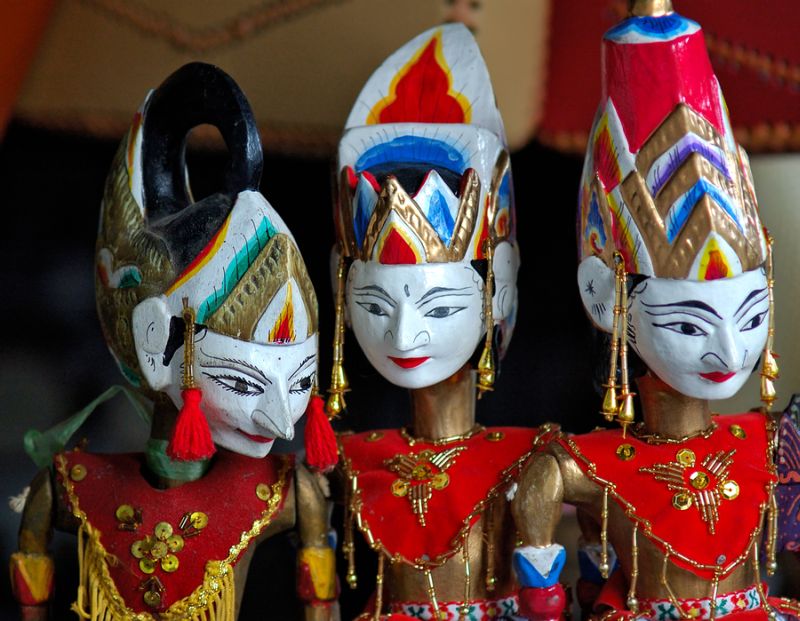
Wooden Puppets show, this performance was inspired by the epic from Persian, but already adopted to local culture. Every Wednesday 10.00 pm - 12.00 n00n at the Meeting Hall of the Yogya Palace.


Javanese dance and ballet performance accompanied by Javanese gamelan orchestra and song, performed every Thursday 10.00 pm - 12.00 noon, at the meeting Hall of  Yogya Palace.


Javanese poetry recital which described the history of the Mataram Kingdom, the antecedent of both Yogyakarta and Surakarta Palace. Every Friday 9.00 am - 11.00 pm at the Meeting  Hall of the Yogya Palace.


Leather puppet shadow performance which performed the fragments story from both the Ramayana and Mahabharata. Every Saturday 4.30 am - 1.00 pm at the Meeting Hall of the Yogya Palace.
It is actually also performed daily in a shorter version at Sono Budoyo museum, just in front of the Sultan Palace at Jl. Trikora, from 8.00 pm - 10.00 pm

The Puppet Museum


This museum is located at southeast of Yogyakarta, is is about 7 km to the east from the city on Jl Wonosari. Built in early 1990, and consists of 4 parts, they are The Puppet & Mask Museum, The Java Architecture Museum, The Indonesia Culture Museum, and The Museum of Forest Plantation.
The Puppet Museum has a good collection of at least 22 kind of puppets made from leather, wood, cloth, paper, and human doll. The mask collection consists at least 8 kind of different mask to be used in either dancing or ritual purposes. Not only the collection of puppet and mask from Indonesia, but it also houses the collection from China, Japan, Thailand, USA, India, Italy, and Austria.

It is also exhibiting clothing collection to be used in the stage  performance of human dancer in either Ramayana or Mahabharata epic story.

Affandi 'The Master'


Affandi Museum is just located at Jalan Solo, at the west bank of the river of Gajah Wong, where you could enjoy at least 300 paintings by Affandi himself. He is a famous and very talented person in painting who has a unique way to do his paintings, using only his fingers.
He never attended the arts school, his talent is a gift from God, since he was very young, where he uused to express his ideas through his paintings. When he got an idea he will then put it in a canvas using his fingers on his hands, just like a person on 'trance', and he will finish his job very soon.
Most of his paintings are 'ultra expressionist', probably one of the only small numbers of painters of this kind in the world.
He was a simple man, always wearing a T-shirt and 'sarong', a Javanese style clothing for leisure time. His great talent inherited by his daughter Kartika, who now become the owner of the museum as well as the curator

The Royal Wedding


The old centuries ceremony which is actually the harmonic combination between Islamic and Hindu, influenced by the Javanese Royal Family culture, will be accompanied by the mystical sound of Javanese percussion orchestra or 'gamelan' reverberated throughout the sprawling ornate Yogyakarta Sultanate Palace, where the royal wedding was held last time.
Both the bride and the groom dressed in specially designed and made motif batik clothes, then a special traditional dance which was created by the late Sultan himself long time ago, also performed by nine female dancers from the royal family who is still virgin.
According to the wedding committee, at least two tons of various flowers primarily roses of different colors and jasmine utilized during the ceremony.
To allow the resident of Yogyakarta to witness this rare opportunity to catch a glimpse of the Royal Coupled , there was also a parade featuring horse carriages which was pulled by six horses, where the bride and the groom crowdaround surrounded the palace.

wedding

The Javanese Keris


The traditional pointed weapon of Javanese which always brought everywhere in the past times especially by Javanese nobel where it could also show the social status of the owner. This culture
predicted start in the VIth century, and then spread to allover Indonesia and surrounding countries included Malaya (now Malaysia), the Philippines, Thailand, and Cambodge. The name and terminology of the keris itself was founded in Java in the year of 824, but the oldest keris was discovered in Magelang Regency, Central Java in the year of 500.
The length of the keris is ranging from 35 cm to 50 cm and also depending upon from where it was made. It is also consiidered as " a masterpiece of the oral and intangible heritage of humanity " by the UNESCO and this declaration was base upon not only the historical value but also the fact that the tradition of Javanese keris is actually a living culture, which is still exist until today, and have both special and unique status in the Javanese society.

Centre of handicraft


For wood carving, the centre is located about 30 km southeast of Yogya at Bubung, lies on a hilly area with fresh air, where almost the villagers are wood carvers who make masks, statues, and typical Yogya bridal statue, called 'Looro Blonyo'. They also offer a classical love story mask dance.
Bamboo handicrafts village is centered in Tietoadi, Sleman, it's about 8 km west of Yogyakarta, where visitors could get the products directly from the craftmen or perhaps you want to learn how to make it, they're reday and happy to teach you all.
Wrought iron makers center is located about 60 km east of Yogya, at Gorotan village. They produce old style lamp, ornamental iron works, garden furniture and other made ot order works.


Wicker work products are made in Moyudan, 12 km west of Yogya where visitors can learn how to amke a simple wicker. Whie glass painting arts can be found at Muntilan, whiich featured either Rmayana epic or Islamic themes. It's close to the Borobudur Temple.
Copper goods are produced in Cepogo village, Boyolali, about 60 km north of Yogya, just below the volcanic mountain of Merapi. They produce pots, pans, home accesories, lighting fixtures, sculptures etc. While terracota, pottery, and all about earthenwares are produced in both Bantul, about 10 km south of Yogya and Klaten county, about 30 km east of Yogya.
Gold and silver craft can be found mostly in Kotagede the southpart of Yogya, where you could get a lot of variety products of silver and gold while visiting the old city of Yogya villlages with its
specific architectures and life style.
Bon voyage !

Cultural Villages


These villages are located around the centrum of Yogya, i.e. the Sultan Palace, where each village has its own uniqueness to offer to visitors, like the architecture of the buildings, the daily life and activities of its people, such as farming, animal husbandry, and cultural activities , including traditional dancing performances and arts exhibitons.


Some ot them are, Tembi Village, located about 8 km south of Yogya, where visitors can stay in a home stay runs by villagers and enjoy traditional performances and art exhibitions.
Kebon Agung Village, it is located 17 km southeast of Bantul Regency, where visitors can observe farmers' daily activities like cultivation and animal farming, they also offer traditional performance and food festival as well.


Sleman Regency has Tanjung Village, located 10 km north of Yogya, where visitors can enjoy the Javanese hospitality while feeling the sense of living in a village inside the 200 year old traditional Javanese home. You might learn how to do rice farming or duck shepherding as well.

The River of Code


Unlike The Thames in London, The Seine in Paris and The Tibre in Rome, the Code river is not just a river which cuts through the city, it is actually a home, a community of the poor, who have nowhere to live and stay in a formal living spaces. Most of them are migrant workers, included an ex criminals, buskers, pickpockets, pedicab drivers, even prostitutes, and perhaps many more unusual positions, you just name it.
It also become a centre of activities and life as well where despite of the dark grey-brown with buoyed rubbish, they use the water of the river to bath and wash the cloth. Miraculously, they're well so far, thanks God ! (probably not yet get the disease, who knows ?).
This community also contains some small scale industries, like tofu home industry, and herbal traditional medicine makers. All of them exist here, people who escape from social expectations and mostly have unconventional jobs.
Everything has its own good and bad side, and the Code river might be the ugly side of the city of Yogya, where you won't go fishing here, will you ?

Cave exploring


Here in Yogya and surrounding areas in Java, caves means magical and mystical as well, where many of them have been used for religious purposes for centuries, and still continue then.
For those who would like to explore, Yogya offers caves accessible to all of you which have a variety
purposes. Beside for recreational adventures and ecological as well geological, historical and scientific data, caves play an important role and both cultural and social heritage.
In a hilly areas of Menoreh, about 9 km northeast of Borobudur Temple, there is a famous cave named Sendang Sono , it's a sacred cave for Catholics where you may find a statue of Virgin Mary in the hillside. To be there, you have to go through a narrow trail as the "Crucifixion Path", to reach the Holly Spring, where water is taken to the Virgin Mary to be blessed. It's believed that the water can heale diseases, purify soul, and bring peaces to all people.

At Dieng plateau, beside the eight Hindhu Temple from 8th century, it might be the oldest in Java, surrounded by boiling mud volcanoes, colored lakes, sulphur outlets and undergrounds channels, there are at least three caves, i.e. Semar Cave, Sumur Cave, and Jaran Cave. Inscriptions dating to 1210AD have been found here.
About 35 km south of Yogya, located in a densed hills of Menoreh there're at least two caves, believed to be the Royal food storage and also a battlefield as told in the Ramayana Epic, which can only be reached by crawling. Sumitro Cave known as the place where the Mahabharata hero medication place, where a lot of people who still believe the magical power of the caves do meditation to gain for fame and fortune.
Selarong Cave located in Bantul Regency, 13 km south of Yogya, which was used for guerilla warfare zone by one of the National Hero of Indonesia, Prince Diponegoro (1825-1830) during the fight against the Dutch colonial government.


In most all caves you will find faunas which are different, like bats, swallows, which produce nests favored by Chinese to be an expensive gourmet soup.
Whoever are exploring caves and regardless of the reasons, they should be careful not to damage cave walls and fragile formations, which take centuries to build. The ecology and the life population should not be disturbed.
Please appreciate and preserve them for many purposes, since they preserve many values of hidden worlds.

Cave Diving


It actually is not for family fun holiday, since it needs an experience, special equipments, and not to mention a brave heart. Extreme adventures can be found at Pegunungan Sewu, Gunung KIdul Regency, where a chain of some 50.000 karsthills perforated with fast caverns, fissures and underground streams, which stretched about 85 km along the south beach of Yogya by The Indian Ocean.
It's named a World Natural Heritage Site in 1994 by The International Union of Speleology 'the exploration and study of caves'. The scientists also discovered nearly 500 caves and tracers of ancient life as well, and concluded that there was a settlement here in The Mesolithic Period (10000 yrs ago ).


Even an Hippopotamus fossil were founded here in Sengok Cave.
For spenlukers, Jamblang Cave and Grubug Cave in Gunung Kidul will be very challenging and thrilling \, since the first chamber to visit is about 75 m drop by rope, after reaching the floor, you will follow the tunnel leading to stalactites and stalagmites as well to a second chamber.
At the bottom of the cave, about 125 m drop, is a rapid river which is heading to the great ocean, The Indian Ocean, where the imaginary Princess of The South is living in her eternal palace.

Running and Trekking


Try to find out the timetable and the locations as well to joint the activities of Hash House Harriers Club, where you can run in the recreational parks with a tract at Kopeng or Kaliurang.
Or, if you want to satisfy your wild imagination by trekking and climbing the mountains and enjoy the mystical volcano of Mount Merapi and view from a close distance.
You can chose whether gazing at spectacular lava views or visit the observation point for a closer view, or probably just take a stroll through friendly villagers and thousands variety of plantations and chat to local villagers.
After all it's your choices ! Have a nice day !

rafting


Yogya has at least three area rivers to do this activities for those who love challenges and enjoy spending times to tame wild rivers in a breathtaking scenery and surrounded by mountains. For beginners, try Elo River just close to the Borobudur Temple, or Progo River for advanced rafter, and Serayu River for more adventurous rafting experiences. Have a good day guys !

The Merapi Volcano


It just like a smokey sleeping giant, one of the most active volcanoes in the world, camouflaged in a sleepy and tranquil forest. Beyond this, you would find a vast stretches of deserted land laying deep in the steep valleys trailing amongst the hills.The pines and wild grass are the dominant vegetation.
During the resting time between the volcanic activities, a lot of hikers, nature lovers, environmentalists climb and observe the mystical and magical mountain to feel and experience as well the magical pulling power and enjoy the abundance of both flora and fauna, and also the natural beauty.
Watch the Merapi from the observation point at Plawangan, reached via a forest trail from Kaliurang to see the incredible views of molten rocks, bubbling mud and hot lava pouring forth and leaving a long trails of smoke. You might visit Trumpon Point to find out children park, running track, and artificial lake.

Fishing:
It is an activity which can give you an opportunity to be alone and contemplate as well far from the noisy city life, enjoy the tranquility of nature, spend the relaxing and privacy time with friends or family. In Turi and Cangkringan villages you might satisfy your needs to fish and to taste fishes in freshwater ponds provided by restaurants, which would prepare your caught fishes into a tasty food.
Or you might visit the beach of Wedi Ombo, it's about 40 km south of Yogya to get the fishing place for sea fishes. It's a wide bay with white sands and has a slope gently, surrounded by lime stone hills. It has a very relaxing atmosphere where the rythm of the waves together with the refreshing wind make the sound of tranquility.
You could also enjoy the sunset scenery both from the hilly areas or from the shore