Custom Search

Javanese herbs and spices


Indonesia, especially Java has a lot varieties of both herbs and spices, to be used for medications as well as seasoning which make food tasty and delicious as well. Some spices to be used in  both flavoring food and traditional medication, like ginger, garlic, chili, clove, galangal, nutmeg, lemon etc.
Clove itself had already been used for centuries in China and India to heal cough, fever, painkiller, muscle relaxant, and not to mention to escape from bad breath and still a lot more useful things.
While ginger beside to omit the stinky smell of both fish and meat, also to increase the endurance and stamina, avoid colds, headache, fever, nausea etc.
Galangal has almost the same specalty like ginger but the taste is stronger, while turmeric to be used as anti inflamatory, liver problem, skin infections/wounds cure, anti cancer and many more useful things.
So, while you taste a delicious meals, yo also benefit  healthyness as well as heal the disease.
What a wonderful world !
 Thanks God ! Bravo Java.

Yogya's regular events


The dance performance of the wayang story, taken from either fragments of the Ramayana or Mahabharata, held every Sunday 9.00 pm -12.00 noon, at the Meeting Hall of the Yogya Palace.


The peprformance of gamelan orchestra, especially 'Yogya style', every Monday and Tuesday, at 10.00pm - 12.00 n00n, at the Meeting Hall of Yogya Palace.


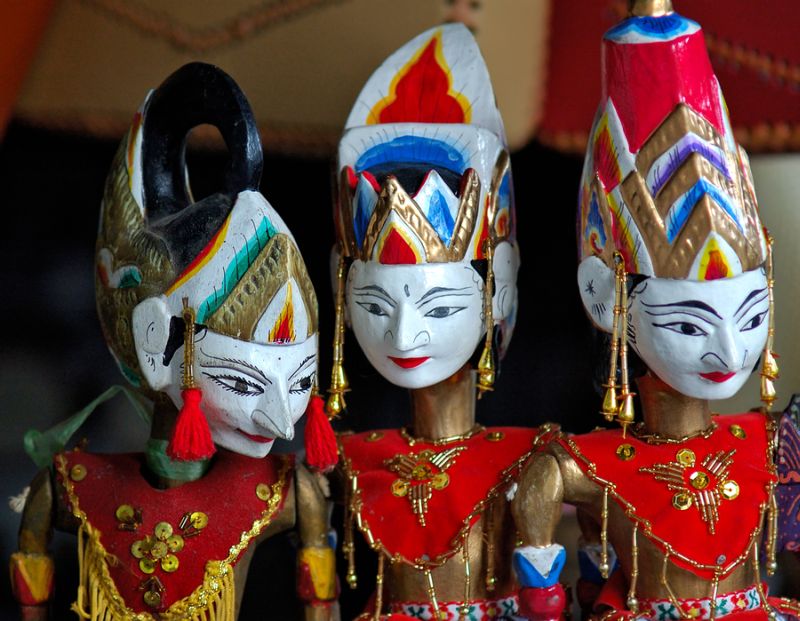
Wooden Puppets show, this performance was inspired by the epic from Persian, but already adopted to local culture. Every Wednesday 10.00 pm - 12.00 n00n at the Meeting Hall of the Yogya Palace.


Javanese dance and ballet performance accompanied by Javanese gamelan orchestra and song, performed every Thursday 10.00 pm - 12.00 noon, at the meeting Hall of  Yogya Palace.


Javanese poetry recital which described the history of the Mataram Kingdom, the antecedent of both Yogyakarta and Surakarta Palace. Every Friday 9.00 am - 11.00 pm at the Meeting  Hall of the Yogya Palace.


Leather puppet shadow performance which performed the fragments story from both the Ramayana and Mahabharata. Every Saturday 4.30 am - 1.00 pm at the Meeting Hall of the Yogya Palace.
It is actually also performed daily in a shorter version at Sono Budoyo museum, just in front of the Sultan Palace at Jl. Trikora, from 8.00 pm - 10.00 pm

The Puppet Museum


This museum is located at southeast of Yogyakarta, is is about 7 km to the east from the city on Jl Wonosari. Built in early 1990, and consists of 4 parts, they are The Puppet & Mask Museum, The Java Architecture Museum, The Indonesia Culture Museum, and The Museum of Forest Plantation.
The Puppet Museum has a good collection of at least 22 kind of puppets made from leather, wood, cloth, paper, and human doll. The mask collection consists at least 8 kind of different mask to be used in either dancing or ritual purposes. Not only the collection of puppet and mask from Indonesia, but it also houses the collection from China, Japan, Thailand, USA, India, Italy, and Austria.

It is also exhibiting clothing collection to be used in the stage  performance of human dancer in either Ramayana or Mahabharata epic story.

Affandi 'The Master'


Affandi Museum is just located at Jalan Solo, at the west bank of the river of Gajah Wong, where you could enjoy at least 300 paintings by Affandi himself. He is a famous and very talented person in painting who has a unique way to do his paintings, using only his fingers.
He never attended the arts school, his talent is a gift from God, since he was very young, where he uused to express his ideas through his paintings. When he got an idea he will then put it in a canvas using his fingers on his hands, just like a person on 'trance', and he will finish his job very soon.
Most of his paintings are 'ultra expressionist', probably one of the only small numbers of painters of this kind in the world.
He was a simple man, always wearing a T-shirt and 'sarong', a Javanese style clothing for leisure time. His great talent inherited by his daughter Kartika, who now become the owner of the museum as well as the curator

The Royal Wedding


The old centuries ceremony which is actually the harmonic combination between Islamic and Hindu, influenced by the Javanese Royal Family culture, will be accompanied by the mystical sound of Javanese percussion orchestra or 'gamelan' reverberated throughout the sprawling ornate Yogyakarta Sultanate Palace, where the royal wedding was held last time.
Both the bride and the groom dressed in specially designed and made motif batik clothes, then a special traditional dance which was created by the late Sultan himself long time ago, also performed by nine female dancers from the royal family who is still virgin.
According to the wedding committee, at least two tons of various flowers primarily roses of different colors and jasmine utilized during the ceremony.
To allow the resident of Yogyakarta to witness this rare opportunity to catch a glimpse of the Royal Coupled , there was also a parade featuring horse carriages which was pulled by six horses, where the bride and the groom crowdaround surrounded the palace.

wedding

The Javanese Keris


The traditional pointed weapon of Javanese which always brought everywhere in the past times especially by Javanese nobel where it could also show the social status of the owner. This culture
predicted start in the VIth century, and then spread to allover Indonesia and surrounding countries included Malaya (now Malaysia), the Philippines, Thailand, and Cambodge. The name and terminology of the keris itself was founded in Java in the year of 824, but the oldest keris was discovered in Magelang Regency, Central Java in the year of 500.
The length of the keris is ranging from 35 cm to 50 cm and also depending upon from where it was made. It is also consiidered as " a masterpiece of the oral and intangible heritage of humanity " by the UNESCO and this declaration was base upon not only the historical value but also the fact that the tradition of Javanese keris is actually a living culture, which is still exist until today, and have both special and unique status in the Javanese society.